
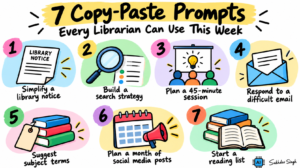
7 Copy-Paste Prompts Every Librarian Can Use This Week
Many people use AI by typing a quick question and hoping for a useful answer. But getting good results is a little like conducting a reference interview. The clearer you are about your role, audience and expected outcome, the more useful the response is likely to be.
Here are seven prompts you can copy, customise and try this week. Just replace the text inside the square brackets.
*1. Simplify a library notice*
“Rewrite this library notice in plain, friendly language for first-year students. Keep it under 100 words. Do not change any dates, deadlines or fines. Here is the notice: [paste notice]”
*2. Build a search strategy*
“I am researching [topic]. Suggest synonyms, broader terms and narrower terms. Then create a Boolean search string that I can adapt for Scopus and Web of Science. Explain how the main search terms are connected.”
*3. Plan a 45-minute information literacy session*
“Design a 45-minute information literacy session on [topic] for [audience]. Include a short opening activity, two hands-on exercises, a brief quiz and a simple way to assess what participants have learnt.”
*4. Respond to a difficult email*
“Draft a polite but firm response to a library patron who has complained about [issue]. Our policy is [policy]. Keep the tone respectful, acknowledge the concern without making unsupported promises, and suggest one practical next step.”
*5. Suggest subject terms for a book*
“Suggest eight candidate subject terms for a book about [description]. Briefly explain why each term may be relevant. I will verify the suggestions against LCSH or our library’s authority file before using them.”
*6. Plan a month of library social media posts*
“Create a four-week social media content plan to promote [library service]. Suggest one post for three days each week. Keep each post under 40 words and include a mix of practical tips, service highlights and engaging questions.”
*7. Start a reading list*
“Suggest ten foundational topics that a first-year student studying [subject] should explore. For each topic, provide one or two useful catalogue search keywords. Avoid inventing book titles or references, and identify any suggestions that need further verification.” Three habits that improve your prompts
– *Give AI a role.* For example, ask it to respond as an academic librarian or information literacy instructor. – *Specify the audience and format.* A notice for first-year students needs a different approach from a research guide for doctoral scholars. – *Set clear boundaries.* Mention word limits, tone, required details and anything that must not be changed.
*One final reminder:* AI can help you prepare a first draft, but professional judgement still matters. Subject headings, reading lists, search strategies and policy-related responses should be checked before they are used.
Choose one prompt, try it today, and share your experience with the group. What worked well? What needed correction? Those practical lessons may help another librarian get better results.