
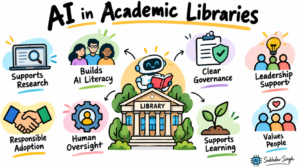
AI adoption in academic libraries is not just about technology. It is about organisational readiness, people and responsible practice.
A recent study presented through the International Federation of Library Associations and Institutions (IFLA) examines how academic libraries in the United States are adopting AI-powered research assistants integrated with discovery systems.
The study, Organizational Adoption of Artificial Intelligence in Academic Libraries, by Jungmin Byun and Yong J. Yi, draws on semi-structured interviews with 21 librarians from different types of institutions and professional roles.
One finding deserves particular attention: successful AI adoption depends on much more than access to the right technology.
It also requires:
• AI literacy among library professionals • Leadership support and organisational readiness • Clear governance and responsible use policies • Transparency and appropriate human oversight • An institutional culture that encourages learning and thoughtful experimentation
The study also reinforces an important principle: AI should support librarianship, not replace it.
For academic libraries, this means using AI to assist research and information discovery while protecting the values that underpin library services, including critical thinking, learning and informed judgement.
There is a practical lesson here for library leaders. Before investing in AI tools, institutions need to consider whether their people, policies and working culture are ready to use them responsibly.
Technology may provide the capability, but people and institutional decisions shape how that capability is used.
The question for academic libraries is no longer simply whether to adopt AI, but how to adopt it responsibly, with a clear purpose and appropriate human oversight.
Source: Byun, Jungmin, and Yi, Yong J. (2026). Organizational Adoption of Artificial Intelligence in Academic Libraries. International Federation of Library Associations and Institutions (IFLA).
Source URL (plain text): repository.ifla.org/handle/20.500.14598/7449
Direct PDF: repository.ifla.org/bitstreams/26953fd5-9d70-42d5-88c2-abe119c0ced8/download