
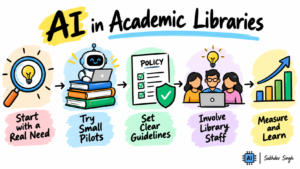
Ithaka S+R’s *AI in Action* initiative provides an interesting example of how academic libraries can explore AI through practical projects and shared learning.
Here are five lessons worth considering.
*1. Solve a real problem first.* Identify repetitive tasks in cataloguing support, collections management, repository workflows or documentation before selecting an AI tool.
*2. Policies matter as much as technology.* Staff need clear guidance on confidential data, copyright, accuracy, acceptable use and human review.
*3. Start with pilots, not large-scale adoption.* A small project with defined objectives makes it easier to test results, identify risks and learn from mistakes.
*4. Bring library staff into the process.* The people who understand everyday library operations should help choose, test and evaluate AI applications.
*5. Measure the results honestly.* Track time saved, output accuracy, errors, staff experience and service quality. If a tool creates more work than it removes, rethink its use.
I see particular relevance for Indian academic libraries, including institutions with limited budgets and small teams. A modest, carefully evaluated pilot may provide more useful learning than adopting multiple tools without a clear purpose.
The larger lesson is that responsible AI adoption is an organisational exercise as much as a technological one.
Libraries have always helped people assess information critically. That responsibility remains just as important when AI becomes part of their own operations.
*Source:* Ithaka S+R, *Exploring AI for Academic Library Operations* sr.ithaka.org/blog/exploring-ai-for-academic-library-operations/