
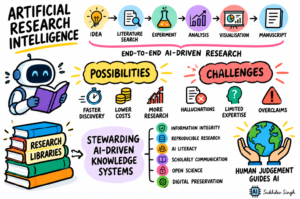
Michael Ridley’s recent paper, *Artificial Research Intelligence: Autonomously AI-Generated Science and the Implications for Research Libraries*, explores this emerging shift.
Artificial Research Intelligence (ARI) goes beyond using AI for literature reviews, coding or writing. The aim is an end-to-end research process:
*Idea → hypothesis → literature search → experiment → analysis → visualisation → manuscript*
The possibilities are significant: faster experimentation, lower costs and the ability to explore many research questions in parallel.
But there is a catch.
Current ARI systems still struggle with hallucinated citations, weak experimental designs, overclaiming results, limited domain expertise and difficulty generating genuinely novel research questions.
This raises an important question:
*Can AI perform the computation without providing the judgement?*
The paper also discusses *epistemic capture* — the possibility that private AI companies could increasingly influence what gets researched, discovered, prioritised and accepted as knowledge.
This has direct implications for research libraries.
Libraries may need to move beyond managing collections and become active stewards of AI-driven knowledge systems, with greater emphasis on:
• Provenance and information integrity • Reproducible research • AI and critical AI literacy • Scholarly communication • Open science and open access • Digital preservation • AI research infrastructure • Library-based AI labs
One idea from the paper particularly stayed with me:
*AI can do the reckoning. Humans still need to provide the judgement.*
The real challenge may therefore not be whether AI can produce more research, but whether our institutions can continue to decide *what is worth knowing, what deserves trust, and who controls the systems through which knowledge is produced.*
Article: doi.org/10.5860/ital.v45i3.17706