
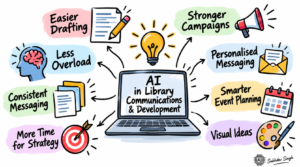
I came across an interesting article on how AI is being used in communications and development work within academic libraries.
What stayed with me was not simply the idea that AI can “write faster”. The more interesting point was how it can reduce *cognitive overload*.
Tywanda L. Cuffy describes her journey from resisting AI to using it as a practical part of her professional workflow. Her experience offers several useful lessons.
*AI works better when we give it context.*
Instead of asking for generic content, she began providing audience information, institutional priorities, tone, campaign objectives, donor considerations, calls to action and event details.
That changes the role of AI. It becomes less of an automatic writer and more of a thinking and drafting partner.
Some practical applications include:
• Developing campaign messaging for different audiences • Preparing donor acknowledgement and stewardship drafts • Adapting annual-giving messages for different groups • Preparing event schedules, invitations and leadership briefing material • Developing visual concepts that can later be taken to a designer • Organising scattered thoughts before moving into editing and strategy
But there is an equally important second half to the story.
AI still cannot understand a grieving donor, institutional history, organisational sensitivities or the emotional weight attached to particular words in the same way a human professional can.
So the human role does not disappear. It remains central to *judgement, empathy, ethics, relationships, strategy and context*.
For academic libraries and higher-education institutions, perhaps the more useful question is not:
“How much of our work can AI do?”
It is:
“Which parts of our work can AI help us handle, so that we have more time for the parts that genuinely require people?”
That distinction matters.
*Reference:* Tywanda L. Cuffy, “Leveraging AI for Communications and Development Work in Academic Libraries”, *Journal of Advancement, Communication, and Development in Academic Libraries*, Vol. 2, No. 1 (2026).
libjournals.mtsu.edu/index.php/jacdal/article/view/2794/1685