
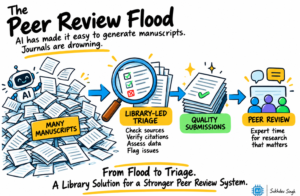
Academic publishing has a growing problem. But one part of the solution may be sitting outside the editorial office.
AI has made it easier to produce manuscripts that look like research. The language is fluent, the structure is familiar, and the references appear convincing. Yet a polished paper is not necessarily a reliable one.
Recent research and reporting point to mounting pressure on academic publishing. Submissions are rising, editors are struggling to manage the workload, and concerns are growing about the use of AI in both manuscripts and peer reviews.
The question is no longer just how to find more reviewers.
*It is how to decide which papers deserve expert attention in the first place.*
This is where *library and information science* deserves a place in the conversation.
Before a manuscript reaches a specialist reviewer, several questions need to be asked.
Are the cited publications genuine? Do they support the claims being made? Are the data and methods described clearly? Do the reported results warrant closer examination?
These checks cannot establish whether a scientific conclusion is correct. That requires disciplinary expertise. But they can help editors identify potential problems before a reviewer invests hours in a detailed assessment.
*Research librarians and information scientists already have relevant expertise.*
Subject librarians understand the literature in their fields. Data librarians work with datasets, documentation and provenance. Systematic review specialists know how to locate, organise and assess evidence across large bodies of research.
These are not peripheral skills. They could help build a better first stage of editorial screening.
Imagine publishers working with information professionals to develop procedures for verifying references, checking whether citations support the claims attributed to them, flagging inconsistencies and identifying submissions that need further scrutiny.
AI tools could assist with these tasks, but human judgement must remain central. A warning sign should prompt investigation, not automatic rejection. The use of AI alone should not be treated as evidence of misconduct.
The aim is simple: *give editors better information before they allocate scarce reviewer time.*
Of course, screening alone will not solve every problem. Publication incentives, editorial policies and research integrity also need attention. Librarians should not be expected to judge scientific validity outside their expertise.
Their contribution is different: helping establish whether the information supporting a manuscript is authentic, traceable and ready for expert evaluation.
*This is the real opportunity: make information science part of editorial infrastructure, not merely a support service around research.*
AI has changed the economics of producing scholarly manuscripts. Academic publishing now needs to rethink the process of evaluating them.
Publishers bring editorial experience. Researchers bring disciplinary expertise. Information professionals bring a deep understanding of sources, evidence, provenance and information quality.
Working together, they could build a more careful first stage of peer review, protecting reviewers’ time without confusing polished writing with sound research.
The question is no longer whether librarians have something to contribute.
*It is whether academic publishing is ready to invite them into the room where its screening systems are designed.*
*The peer review flood is an editorial challenge. The first line of defence could be an information science collaboration.*
*References*
1.
*Organization Science* study, reported by Phys.org (May 2026): phys.org/news/2026-05-journal-ai-academic-publishing-quality.html 2.
*Nature* — AI-generated peer reviews (November 2025): www.nature.com/articles/d41586-025-03506-6 3.
*Nature* — Detecting AI-generated peer reviews: www.nature.com/articles/d41586-025-04032-1 4.
ScholarOne submission data, reported by inkl: www.inkl.com/news/the-ai-surge-is-flooding-academic-journals