
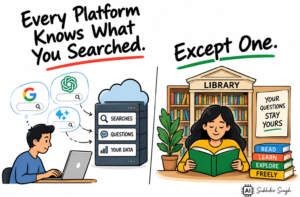
Years ago, a colleague told me about a library director in the United States who destroyed her patrons’ borrowing records rather than hand them over to investigators.
It was not an accident.
She knew exactly what she was doing, and why.
What her readers had borrowed, she believed, was not the government’s business. She had made that decision long before anyone came asking. When they eventually did, she acted on it.
I have thought about that story many times since. I am thinking about it again now.
When you search Google, there is a record of what you searched. When you ask ChatGPT a question, that question does not simply disappear. When you use an AI research tool at work, your research trail may become part of a system that can retain, analyse or otherwise use that information.
The tools helping us find things are also learning from what we want to find.
That is not an obscure technical detail. It is part of how many digital services work.
*Libraries are different.*
Patron privacy is not a modern feature added to an old institution. It has been part of librarianship for decades.
The principle is straightforward: people should be able to read, search, learn and ask questions without worrying that their intellectual curiosity is being recorded and may later be used against them.
Librarians have defended this principle in court. Some have destroyed records rather than surrender them.
Not because they wanted to obstruct legitimate investigations, but because they understood something fundamental:
*The freedom to inquire depends, in part, on the freedom to inquire without being watched.*
Think about that for a moment.
Someone researching a medical condition.
Someone trying to understand a legal problem.
Someone quietly exploring a political idea.
Someone dealing with a personal crisis.
They open an AI tool and ask for help.
The answer may be useful. But there is another question sitting quietly behind it:
*What happens to the question afterwards?*
Who stores it?
Who can access it?
How long is it retained?
What might be inferred from a pattern of questions?
Even when people do not know the answers, they often change their behaviour. They phrase the question differently. They leave something out. Sometimes, they decide not to ask at all.
That is self-censorship, even when it happens quietly.
Libraries were built around the opposite idea.
They gave people access to knowledge without asking them to surrender their curiosity in return.
So, in an age when almost every digital information transaction can leave a trail, perhaps the library is not an institution that failed to keep up with technology.
In some ways, it is an institution that preserved something technology forgot.
The most radical idea in our information economy may also be one of the oldest ideas in librarianship:
*What you wanted to know should not automatically become somebody else’s business.*
No wonder librarians fought to protect those records.
And no wonder some were willing to destroy them.