
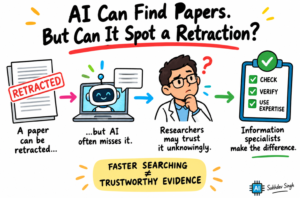
In my years of working with biomedical literature, one thing I was always careful about was *retracted articles*.
A retracted paper does not disappear.
The original article remains online. PDFs downloaded before the retraction continue to circulate. Citation managers may still contain the old record. A researcher who finds only the original paper may have no obvious indication that the study was later withdrawn.
I knew this. I checked. That checking was part of the job.
A study published in the *Journal of Medical Internet Research* in May 2026 tested nine AI tools against 15 retracted articles from the Retraction Watch database.
The tools included ChatGPT 4, ChatGPT 5, Claude, Gemini, Perplexity, Copilot, SciSpace, ScienceOS and Consensus.
Each tool was asked five questions about every article, including: *Had the article been retracted?*
The finding deserves attention.
*Not one of the nine AI tools consistently handled retracted literature correctly.*
ChatGPT 5 performed best, correctly answering all five questions for 8 of 15 articles — 53%.
The research-focused tools — SciSpace, ScienceOS and Consensus — did not produce a single fully correct response set across all 15 papers.
Several tools had error rates above 40%. Retracted papers were sometimes included in literature summaries without warning, discussed as valid evidence, or recommended to users who had no way of knowing the research had been withdrawn.
One phrase from the study particularly caught my attention:
*“High linguistic confidence.”*
That is the real concern.
AI can present incorrect or outdated research in fluent, authoritative language. There may be no hesitation, no warning and no visible sign that the source has a serious problem.
We have already seen the consequences with the Wakefield MMR-autism paper. It was retracted in 2010, yet its influence continued long after the retraction.
That was one paper spreading through the information system at human speed.
AI can reproduce and distribute information at machine speed.
This is why verification is not an optional extra. *It is the point.*
Someone still needs to check whether a paper has been retracted, corrected, superseded or otherwise qualified.
That work existed long before generative AI.
*Information specialists have been doing it quietly for decades.*
AI can make literature searching faster. But faster searching does not automatically mean trustworthy evidence.
Until retraction-aware verification is built into AI tools, independent source checking remains essential.
And the professionals trained to do that work have a name:
*Information specialists.*
*Source article:* Labenbacher S, Niederer M, Hammer S, Bader M, Schreiber N, Bornemann-Cimenti H. *Performance of AI Tools in Citing Retracted Literature: Content Analysis.* J Med Internet Res. 2026;28:e88766.
www.jmir.org/2026/1/e88766 pubmed.ncbi.nlm.nih.gov/42066286/