
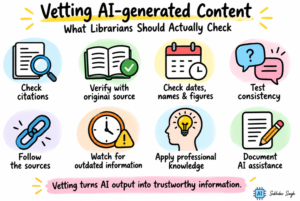
AI tools can produce confident answers whether those answers are right or wrong. That is why vetting matters.
For librarians, this is not just about checking an occasional chatbot response. The same discipline applies to a MARC record, a research summary, a citation list, or information prepared for a patron.
*Here are the checks I would actually make:*
*1. Check for fabricated citations.*
This is one of the most common AI failures. Run every AI-generated reference through Scite or a direct database search before it finds its way into a bibliography or, more importantly, into a patron’s hands.
*2. Verify factual claims against the original source.*
An AI summary of a research paper, report, or policy document is not the final authority. Open the original and check whether the claim is actually supported. Something can sound perfectly plausible and still be wrong.
*3. Cross-check dates, names and figures.*
These are easy places for AI to slip — the wrong publication year, a misspelled author’s name, or a number that is almost right.
Small errors can damage trust very quickly.
*4. Test consistency across different prompts.*
Ask the same question twice, perhaps with slightly different wording. If the answers contradict each other, that is a good reason to stop and investigate before accepting either answer.
*5. Follow the sources behind the claims.*
Tools such as Perplexity and Consensus provide cited sources. Do not stop at the AI-generated summary. Click through, read the source, and check whether it really supports what the tool has said.
*6. Watch for outdated information.*
AI can present old information as if it were current. Anything time-sensitive — policies, statistics, opening hours, regulations, institutional information — should be checked against a current source.
*7. Apply professional knowledge.*
A librarian who understands MARC, metadata, research methods or information literacy may spot an error that another user would easily miss.
That matters.
The tool does not replace professional judgement. In many cases, the quality of the vetting depends on it.
*8. Keep a record of AI assistance.*
For research support and institutional work, it is worth documenting where AI was used. A simple note about the tool and its role in the process can make the work easier to audit and explain.
Vetting is not extra work added to AI use.
It is part of the professional skill of using AI responsibly.
Everything before that is simply generation.
*What is the biggest AI error you have caught during your own vetting process?*