
Ask anyone in the AI industry what makes a language model intelligent and you will hear about transformer architectures, attention mechanisms, neural networks, training at scale. All of it true. None of it the full picture.
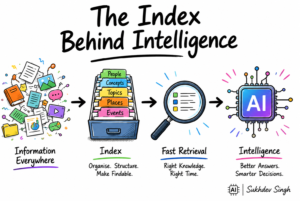
At the base of every system that retrieves, ranks, and surfaces knowledge is an index. Always has been, always will be. The index is what makes search possible. It is what allows a system to go from a question to an answer in milliseconds rather than scanning every document it has ever seen from the beginning. The sophistication of the model sitting on top of that index can be astonishing. But remove the index and the intelligence collapses into chaos.
Now here is the question nobody in the AI industry seems to be asking. Who built indexing theory?
Not the computer scientists. Not the engineers. The people who spent decades thinking systematically about how knowledge should be organized so that it could be found were information scientists. Ranganathan. Mooers. Lancaster. The theoretical foundations of information retrieval, faceted classification, relevance ranking, controlled vocabularies, inverted indexes, were built by people whose professional home was library and information science, not computer science. The field of information retrieval that produced the intellectual scaffolding for modern search was, for most of its history, a library science project. This matters for a reason that goes beyond historical credit, though the credit is overdue. It matters because the hardest unsolved problems in AI right now are indexing problems in disguise. How do you decide what goes into the training corpus and what stays out? That is a collection development problem. How do you ensure that retrieval surfaces the most authoritative source rather than the most popular one? That is a subject indexing problem. How do you build a knowledge graph that captures the relationships between concepts accurately enough to support reasoning? That is a classification theory problem. The engineers working on these questions are, in many cases, independently arriving at solutions that information science built frameworks for thirty years ago.
The index behind the intelligence was never invisible to us. We built it, refined it, and taught it in library schools for generations before anyone thought to call it artificial intelligence. What we have not done well enough is say so in rooms where it would change how people think about who belongs in those rooms.
That changes now.