
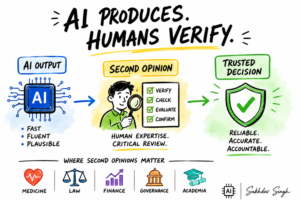
Medicine learned this lesson the hard way.
A single diagnosis, however expert, is not always enough when the consequences are serious. You seek a second opinion. Not because the first doctor is incompetent, but because the stakes are high enough to make a single point of failure unacceptable.
The second opinion does not replace the first diagnosis. It stress-tests it.
Most systems we trust with important decisions have some version of this built in.
Peer review in scholarship. Appeals in law. Audits in finance. Parliamentary oversight of executive decisions. External examiners in doctoral assessment.
These mechanisms are not signs that the primary system cannot be trusted. They are part of how trust is created in the first place.
A reliable system is not one that assumes the first answer will always be right. It is one that has a way of finding out when it is wrong.
AI, by itself, does not have that second-opinion mechanism.
A language model can produce a clinical summary, legal argument, financial analysis or literature review in seconds. But there is no peer reviewer sitting beside it, no appeals court, no auditor checking every claim before the answer reaches the user.
It produces.
It does not independently verify.
And there is another problem. AI can sound just as confident when it is wrong as when it is right. That fluency can remove the very signal that normally makes us pause and check.
A hesitant answer invites scrutiny.
A confident answer often gets passed along.
This is not an argument against AI’s capabilities. It is a structural observation about what is missing from the system around it.
And the profession best placed to provide that missing layer may be the one that has been doing this work for generations: information professionals.
Source verification. Citation checking. Evaluating authority. Cross-referencing claims against primary literature. Distinguishing evidence from assertion.
These are not new responsibilities created by AI. They are established professional practices.
In systems terms, they are error-correction functions.
They take a plausible answer and ask a more important question:
“Is it also true?”
That is where I think the role of information professionals in the AI era needs to be reconsidered.
Not as people waiting to be replaced by AI, but as the *second-opinion layer* in AI-assisted knowledge work.
In research institutions. Hospitals. Law firms. Government departments. Universities. Anywhere AI-generated information is being used to influence decisions that matter.
The second opinion saves lives in medicine.
It protects rights in law.
And in an AI-assisted world, it can protect the integrity of decisions increasingly shaped by machine-generated information.
That function has a professional home.
It always did.
Perhaps what we need now is simply to say it more clearly, and much more often.