
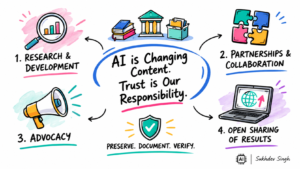
AI can change digital content in seconds. Preserving trust takes much longer.
I recently read the Library of Congress report, Content Authenticity and Provenance in the Age of Artificial Intelligence: A Call-to-Action for the LAMs Community.
For libraries, archives and museums (LAMs), the issue is bigger than whether to use AI.
The deeper question is: How do we know that the digital content we preserve and provide access to is authentic, properly documented and trustworthy?
Generative AI makes this harder. A photograph, recording, document or video can now be altered at a very small level, sometimes without an obvious sign of what changed.
The report makes an important point: provenance and authenticity are not new concerns. Digital preservation has dealt with them for decades. What AI changes is the scale, speed and visibility of transformation.
I found the report’s four-point call to action particularly useful:
1. Research and development — continue testing how existing authenticity and provenance practices need to adapt to AI.
2. Partnerships and collaboration — institutions should share knowledge, tools, standards and lessons instead of working in isolation.
3. Advocacy — LAMs should actively influence industry standards and push for open, vendor-agnostic approaches to provenance data.
4. Open sharing — publish experiments, failures and lessons learned quickly, rather than waiting years for everything to reach traditional scholarly channels.
One line of thinking stayed with me: technology can verify certain technical facts, but it cannot replace human judgement about meaning, context, intent or cultural sensitivity.
That distinction matters.
As AI-generated and AI-assisted content becomes more common, preserving the history of a digital object may become just as important as preserving the object itself.
For heritage institutions, the answer may not be one tool or one standard. It will require good documentation, thoughtful governance, technical capability and, above all, people who understand what should and should not be trusted.
A timely report for anyone working in digital preservation, archives, libraries, museums, cultural heritage or AI governance.
Source: Library of Congress, February 2026 blogs.loc.gov/thesignal/files/2026/04/Call-to-Action-CAP-for-LAMs.pdf