
I came across a report last week that made me stop scrolling and think for a while.
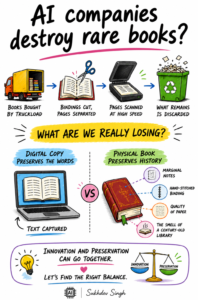
To train large language models, some AI companies have reportedly been buying physical books by the truckload, cutting off the bindings, feeding every page through high-speed scanners, and then discarding what remains. A U.S. court has ruled that scanning legally purchased books for AI training can qualify as fair use. Fair enough, one might say. But the court was equally clear that pirated books are a different matter.
That, however, leaves a bigger question. When we digitise a printed book, are we preserving its contents, or are we quietly deciding that the object itself no longer matters?
For a paperback with thousands of copies still in circulation, destructive scanning may have little real impact. But the picture changes for an out-of-print title, a limited edition, or a book with only a handful of surviving copies. Once a physical copy is destroyed, it is gone for good.
A digital scan, however detailed, preserves the text. It does not preserve the object. It cannot capture a previous owner’s notes in the margins, the craftsmanship of a hand-stitched binding, the quality of the paper, or even the distinctive smell of a century-old library book. Those details may seem incidental, yet they are part of the history that books carry with them.
I understand why AI developers need high-quality training data. That need is real. But cultural preservation deserves a place in the same conversation, not a brief mention once the scanning is complete. Technological progress and the preservation of our literary heritage do not have to compete with each other. They only come into conflict when we fail to ask where the boundaries should be. Perhaps the real challenge is not whether AI should learn from books, but how we can ensure that innovation moves forward without quietly erasing pieces of our shared history.
I’m curious to hear what the library and information science community thinks. Should destructive scanning be considered acceptable as long as a digital copy survives? Or should rare, historically significant, and culturally important books receive protections that go well beyond the boundaries of fair use?
References:
Ars Technica – Anthropic destroyed millions of print books to build its AI models arstechnica.com/ai/2025/06/anthropic-destroyed-millions-of-print-books-to-build-its-ai-models/
The Guardian – Anthropic did not breach copyright when training AI on books without permission, court rules www.theguardian.com/technology/2025/jun/25/anthropic-did-not-breach-copyright-when-training-ai-on-books-without-permission-court-rules
404 Media – AI Companies Are Buying Tons of Old Books Because They’re Free of AI Slop (original reporting on AI book acquisition and scanning) www.404media.co/ai-companies-are-buying-tons-of-old-books-because-theyre-free-of-ai-slop/