
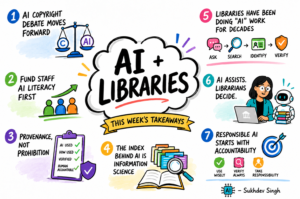
AI is changing libraries. But this week’s discussions reminded me of something equally important: *libraries have been shaping many of the ideas behind AI for decades.*
Here are seven takeaways from the week:
1.
*AI and copyright in India* The Delhi High Court’s interim observations in the ANI–OpenAI case add an important chapter to India’s evolving debate around copyright, AI training and fair dealing. The final legal position is still to come. 2.
*Fund library staff before buying AI for patrons* An AI4LIB community poll found that none of the 24 respondents worked at a library that funded paid AI tools for staff. If librarians are expected to teach AI literacy, they need access to the tools themselves. 3.
*Provenance, not prohibition* Instead of trying to police whether AI was used, scholarly publishing may benefit more from asking *how* it was used and whether the human author verified and took responsibility for the final work. 4.
*The index behind intelligence* Retrieval, indexing, classification, controlled vocabularies and relevance ranking are not new AI inventions. They have deep roots in library and information science. 5.
*Libraries did many “AI” things first* Reference interviews look remarkably like prompt engineering. Controlled searching resembles retrieval-augmented generation. Authority control resembles named-entity recognition. Reference verification resembles hallucination checking. 6.
*AI should assist. Librarians should decide.* Work at Berkeley shows the practical value of this model: AI can help with cataloguing, metadata and large-scale review, while librarians retain responsibility for accuracy, context, privacy and judgement. 7.
*Responsible academic AI is about accountability* Using AI to learn, brainstorm, improve writing or check information can be useful. But students and researchers still need to follow institutional rules, verify outputs and take responsibility for what they submit.
The larger message is worth remembering:
*AI does not make professional judgement obsolete. It makes professional judgement more important.*
Libraries already have much of the intellectual and ethical foundation needed to work with AI. The opportunity now is to bring that expertise into the rooms where AI systems, policies and practices are being shaped.
*The room is already ours.*
#AI4LIB #ArtificialIntelligence #Libraries #AcademicLibraries #LibraryTechnology #AIinLibraries #Research #AIethics #ScholarlyCommunication