
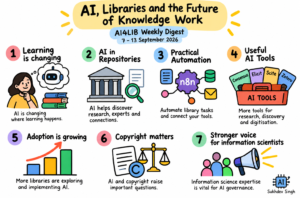
AI, Libraries and the Future of Knowledge Work
AI4LIB Weekly Posts | 7–13 September 2026
AI is not simply changing library technology. It is changing how people learn, discover, evaluate and use knowledge.
Here are the key ideas from this week’s AI4LIB discussions:
1. AI is changing where learning happens R. David Lankes argues that librarians may need to become “accountable conversants”, helping people examine how AI shapes their thinking, not only verify its final answers.
2. AI is entering institutional repositories The open-source Westlake Scholar platform uses AI for contextual paper reading, research-direction discovery, expert discovery and research chronologies, built around trusted institutional records.
3. n8n can connect AI with library workflows AI can classify enquiries, extract metadata and prepare responses, while n8n connects library systems, databases and communication platforms. Librarians remain responsible for professional judgement.
4. The AI toolkit for libraries is expanding Consensus, Elicit, Scite, Zotero, VuFind, DSpace and Google Document AI are among the tools being explored for research, discovery, citation verification, repositories and digitisation. AI-generated metadata still requires verification.
5. AI adoption needs governance Clarivate’s Pulse of the Library 2026 reports different levels of AI adoption across libraries and highlights the importance of library–IT governance and staff productivity.
6. Copyright and AI need library participation Different approaches in the US, Europe and India raise questions about AI training, text-and-data mining, licensing, fair dealing and access to knowledge. Libraries should be part of this conversation.
7. Information scientists need a stronger voice in AI Expertise in knowledge organisation, metadata, retrieval, provenance, evaluation and information ethics is increasingly important as AI systems influence what people discover and trust.
The central message is simple:
AI may transform library services, but libraries still have a fundamental responsibility to help people discover, understand, evaluate and use knowledge responsibly.
What role should librarians and information scientists play in shaping the next generation of AI systems?
*References* [1] arxiv.org/abs/2609.05072 [2] clarivate.com/pulse-of-the-library/ [3] www.stibbe.com/publications-and-insights/ai-copyright-claims-in-europe-key-considerations
#AI4LIB #ArtificialIntelligence #Libraries #InformationScience #AcademicLibraries