
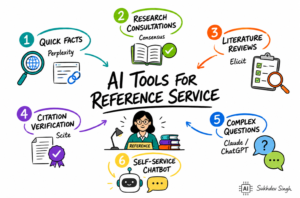
AI is showing up fastest in reference work because so much of the job involves finding, checking, and explaining information. That makes reference a good place to start experimenting, but the tool you choose should depend on the question.
*1. Quick factual and ready-reference questions — Perplexity*
For questions such as “What year did this happen?” or “Where can I find this information?”, Perplexity is a useful first option. Its web-grounded answers include citations, which makes it easier to check where the information came from.
*2. Research consultations — Consensus*
When a faculty member or researcher asks, “What does the research actually say about X?”, Consensus can search across peer-reviewed literature and provide a cited summary. It can save time at the initial stage, while the librarian still checks the underlying papers and databases.
*3. Literature reviews and systematic searches — Elicit*
Elicit is particularly useful when the task involves working across a large number of research papers. For a systematic review consultation, it can be useful to sit with the researcher and use it as part of the search and screening process.
*4. Citation verification — Scite*
Scite can help answer a different question: what happened to this paper after it was published? Looking at supporting and contrasting citations can give useful context when a researcher wants to assess how a source has been received.
*5. Complex reference questions — Claude or ChatGPT*
Sometimes a patron arrives with three papers, a research question, and a request to “help me make sense of all this.”
That is where a general-purpose AI assistant can be useful. It can help compare documents, identify themes, explain differences, and organise a complicated question into something easier to work with.
*6. First-line self-service — a library-specific chatbot*
For routine questions about opening hours, services, borrowing rules, databases, and FAQs, a chatbot trained on the library’s own information can handle a useful share of repetitive queries.
That gives staff more time for the questions that actually need professional judgement.
The bigger point, though, is this:
*AI does not replace reference judgement.*
Knowing which source to trust, what evidence is appropriate, what the patron is really asking, and when an AI answer needs to be challenged — that remains the librarian’s job.
The real gain is time. If AI can reduce the effort spent locating and organising raw information, we can spend more of the reference interaction doing what librarians do best: helping people make sense of information.
*Which of these would change your reference desk workflow the most?*
#AIinLibraries #ReferenceService #LIS #AcademicLibraries