
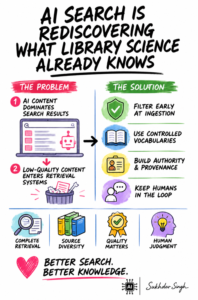
A paper presented at the ACM Web Conference in Dubai this April introduced a term that stopped me when I read it. Retrieval Collapse. The researchers defined it as a two-stage failure: AI-generated content first dominates search results, eroding source diversity, and then low-quality content infiltrates the retrieval systems that everyone depends on. The paper argued that the established approach of filtering at the retrieval stage is already too late, and that the problem must be addressed at the point of ingestion, before the bad content enters the system at all.
Information scientists have a different name for this problem. We call it garbage in, garbage out. We have been teaching it since the first information retrieval course was designed.
The same month, the Journal of the Association for Information Science and Technology published a paper by Birger Hjørland examining what happens when AI systems try to replace trained human searchers in literature retrieval. The numbers are worth sitting with. A fully automated AI approach retrieved less than 30% of relevant papers. A semi-automated approach, where a trained human worked alongside the AI, retrieved over 80% and correctly excluded 92% of irrelevant material. The paper observed that the growing invisibility of sources in AI-generated answers is leading to what it called de-skilling of searching and evaluation. People are losing the ability to search because AI is doing it for them, badly, and they cannot tell the difference.
In March, the ACM Conference on Human Information Interaction and Retrieval hosted a dedicated workshop on generative AI and academic search, examining how AI is reshaping search behaviour in research environments.
Three major research conferences in one quarter. Three separate groups of computer scientists arriving, from different angles, at the same conclusion. AI search has a provenance problem, a diversity problem, a quality problem, and a human judgment problem. The solutions being proposed, provenance graphs, ingestion-stage filters, human-assisted retrieval, source diversity metrics, are being discussed as if they are new ideas requiring new disciplines to solve them.
They are not new ideas. They are library science, restated in the language of computer science because the people who need them most have never read a paper by Shiyali Ramamrita Ranganathan.
The controlled vocabulary exists to solve the retrieval diversity problem. The authority file exists to solve the provenance problem. The reference interview exists to solve the human judgment problem. The systematic review methodology exists to solve the completeness problem that the 30% retrieval figure describes. Information science built frameworks for all of this before most of the researchers now discovering these problems had started their PhDs.
The profession that solved retrieval collapse before it had a name is the profession best placed to solve it now that it does. It would help if the two communities were actually talking to each other.
Sources: Retrieval Collapse paper: ACM Web Conference 2026. doi:10.1145/3774904.3792955
Hjørland, B. (2026). Information retrieval or document retrieval? JASIST. doi:10.1002/asi.70057
CHIIR 2026 Workshop on Generative AI and Academic Search. doi:10.1145/3786304.3787953