
AI4LIB Weekly Digest (31 August 2026 – 6 September 2026)
How should libraries use AI while protecting privacy, professional judgement and access to knowledge?
This week’s AI4LIB discussions point towards an important principle: the future of AI in libraries is not simply about adopting more powerful tools. It is about deciding where AI should run, how it should be governed, what data it should access, and where human judgement must remain central.
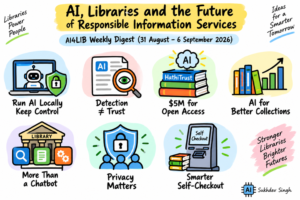
1. Run AI locally, keep control locally — Open-weight models are becoming practical for academic libraries, offering options for document analysis, metadata work and research while keeping sensitive data within institutional infrastructure. [1]
2. AI detection is not the same as trust — Identifying AI-generated content may improve transparency, but disclosure alone cannot establish authorship, provenance, originality or research quality. [2]
3. HathiTrust puts public-interest AI into practice — HathiTrust has received a $5 million, five-year Mellon Foundation grant to develop transparent AI-enabled discovery and research services around its 19 million digitised volumes. [3]
4. AI can assist collection development — Libraries can use AI to analyse catalogues, usage patterns and collection gaps, but acquisition decisions should remain with librarians and protect patron privacy.
5. The AI-ready library is more than a chatbot — Discovery, cataloguing, acquisition, circulation, reference, collection analysis, OCR and predictive analytics are emerging areas where AI can augment library workflows while keeping professional judgement central.
6. Library privacy matters even more in the AI age — Search and AI interactions can leave digital trails. Libraries have an opportunity to defend intellectual freedom by ensuring people can explore information without unnecessary surveillance.
7. Self-checkout kiosks can become smarter — Computer vision, AI troubleshooting, anomaly detection, predictive maintenance and usage analytics could reduce routine kiosk problems and free staff to spend more time helping patrons.
The larger question is not simply, “Does our library have AI?”
It is: “How can we use AI to improve library services while keeping librarians, users, privacy and responsible governance at the centre?”
What do you think should be the highest priority for libraries as AI becomes part of everyday library services?
Compiled from AI4LIB daily updates.
Regards, Sukhdev Singh.
References
[1] www.choice360.org/libtech-insight/ai-for-academic-libraries-open-weight-ai-models-for-local-and-private-use/ [2] scholarlykitchen.sspnet.org/2026/08/31/we-can-now-track-ai-generated-content/ [3] www.hathitrust.org/press-post/hathitrust-receives-grant-to-deliver-ai-enabled-access-to-digital-books/