
Acquisitions is one area where AI can start saving time quite quickly.
Why? Because so much of the work involves analysing data, checking lists, finding overlaps and preparing budget justifications.
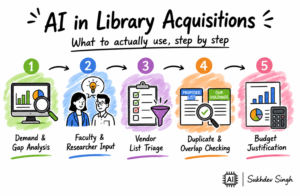
Here are five practical places to start.
1. Demand and gap analysis
Before placing the next book order, analyse circulation and ILL request data using ChatGPT or Claude with code execution.
Ask the tool to identify subject areas where demand is high but holdings are thin.
That changes:
“We probably need more books on this subject.”
into:
“Our users requested 47 titles in this area, but our holdings are limited.”
That is a much stronger basis for a purchase decision.
2. Faculty and researcher requests
Tools such as Consensus can help cross-check recent literature in a discipline.
This is useful when a department proposes a large standing order.
If the request does not match current publishing activity in the field, it gives you something concrete to discuss before the PO is raised.
3. Vendor list triage
Approval plans and vendor slips can contain hundreds of titles every month.
Give the AI tool your collection development policy along with the title list.
Ask it to flag titles that clearly fall outside your scope.
You still make the final decision.
But the first screening can take minutes instead of hours.
4. Duplicate and overlap checking
Before buying a new database or e-book package, compare the proposed title list with your existing holdings export.
AI can quickly flag likely duplicates and areas of overlap.
A spreadsheet exercise that once took an afternoon can become a much faster review.
5. Budget justification
AI can also help turn existing usage statistics into a concise budget narrative.
For example:
• Cost per use • Three-year usage trends • Changes in demand • Comparison with peer institutions, where reliable data is available
The numbers remain yours.
AI simply helps present them clearly.
The important part?
None of this replaces professional judgement about what belongs in a library collection.
It removes some of the repetitive work involved in getting to that decision.
For me, that is where AI makes the most sense in acquisitions:
*Less time on mechanical checking. More time on actual collection development.*
If you handle acquisitions, which part of this workflow would save your library the most time?