
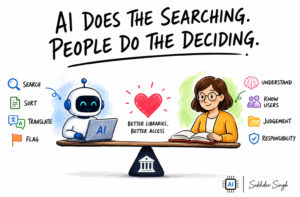
At Berkeley’s East Asian Library, a librarian is cataloguing nearly 2,000 Chinese film posters. Upload one, and within seconds AI translates the text and drafts a description. Neat, fast, useful. But the librarian still decides whether that description is actually right. As Haiqing Lin, who leads technical services there, puts it, the librarian understands the collection, the users, and the cataloguing system in ways the AI simply does not. AI is being taught what is needed. It is not being handed the final say.
There is more happening at Berkeley than posters. Agricultural publications from the 1960s and 70s, long buried and undiscoverable, are now searchable because AI helped generate metadata for them. Material that researchers had effectively lost access to is back in circulation. Archivists are using AI-assisted scripts to flag sensitive information such as Social Security numbers buried in large digital collections, so staff can review and clear it before anything goes public. Neither of these replaces a person. Both save a person from days of tedious searching so they can spend that time on the judgement calls that actually need a human.
Librarians there worked with researchers and policymakers to create legal space for scholars to analyse films at scale, which let one team study thousands of films to track how race and gender have been represented over time. That is not cataloguing. That is the library stepping into a role it has not traditionally played: helping people understand what they can legally do with material, not just where to find it.
None of this comes free of worry, of course. Copyright, privacy, the environmental cost of running these systems, accuracy, and the quiet risk of trusting AI output without checking it properly. Berkeley is building an AI framework around human judgement, transparency, privacy, and fair access, which tells you they are taking these concerns seriously rather than waving them away.
I do not think the lesson here is that AI makes libraries faster. I think the lesson is narrower and more interesting than that: AI works best when it does the searching, and people keep doing the deciding.
Libraries have absorbed new technologies before, from card catalogues to OPACs to full digitisation, and each time the profession worried it would lose its purpose. It never did. AI is just the next test of the same old question: can the tools change without the judgement disappearing with them?