
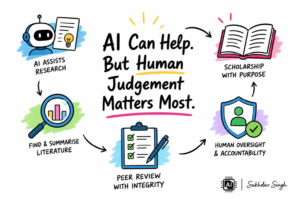
AI can help us write faster. But should it also decide what deserves to be believed?
I recently read an editorial by Ellen Taylor, PhD, AIA, MBA, EDAC, on scholarly publishing in the era of artificial intelligence. It left me thinking about a question that goes beyond AI tools:
*What happens to research when humans slowly stop doing the thinking themselves?*
The editorial points to several developments that deserve serious attention.
AI agents are now capable of surveying literature, generating hypotheses, conducting research, and producing papers. In one reported experiment, an AI-generated paper passed peer review before being withdrawn as part of the study protocol.
At the same time, AI is already being used in peer review. Researchers are using it to draft reviews, summarise findings and even identify possible misconduct. Yet studies cited in the editorial suggest that AI-generated reviews can imitate the structure of peer review without providing the depth of constructive criticism that human reviewers bring.
There is another issue that I find even more interesting.
Researchers are increasingly using AI to find and summarise literature. That sounds helpful, especially when the volume of published research is overwhelming. But reading a paper is not only about collecting information.
It is also about developing judgement.
When we spend time with a body of research, we begin to understand its assumptions, limitations, context and contradictions. A summary can give us the answer, but it may not give us the understanding that comes from doing the work ourselves.
The editorial describes the risk as a *“circular crisis”*: research summarised by AI, research conceived and conducted by AI, papers written by AI, and then AI systems reading those papers to inform the next generation of research.
That is a fascinating possibility. It is also a worrying one if human oversight becomes superficial.
The answer, in my view, is not to reject AI.
It is to be much clearer about where AI assists scholarship and where human judgement must remain accountable.
The distinction is already appearing in publishing policies. For example, the editorial notes that language and grammar assistance may be acceptable in some circumstances, while fabricated data, false references, inappropriate attribution and AI-generated research content require much greater scrutiny or are prohibited.
Perhaps the most important line is the simplest:
*An LLM does not think and interpret. People do.*
AI can help us process more information.
But scholarship still depends on people who are willing to question, verify, reflect and take responsibility for what they publish.
That responsibility cannot be outsourced.
Source: Ellen Taylor, “Scholarly Publications in an Era of Artificial Intelligence,” Health Environments Research & Design Journal, 2026.