
Self-checkout kiosks have been around for years. For most libraries, they have meant a barcode scanner, a screen and, sometimes, an RFID reader.
What is changing now is what happens *behind* that screen.
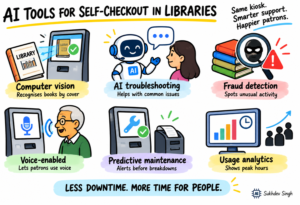
*Computer vision for shelf-free checkout.* Computer-vision systems can identify books from their cover images rather than depending entirely on barcodes or RFID. This could be useful for older collections where tagging every item with RFID would be expensive or simply impractical.
*AI-assisted troubleshooting.* A small chatbot, built with a custom GPT or another AI assistant and trained around the kiosk’s common error messages, could guide patrons through problems such as stuck holds, blocked accounts or failed checkouts. The aim is simple: solve the easy problems without immediately calling a staff member.
*Fraud and error detection.* Retail self-checkout already uses anomaly detection to spot unusual behaviour. Similar approaches could help libraries identify repeated failed scans, unusual checkout patterns or other errors in the background, without turning the kiosk into something that constantly interrupts patrons.
*Voice-enabled kiosks.* Voice interaction is another area worth watching. Libraries could use services such as Amazon Lex or Google Dialogflow to let patrons complete or troubleshoot parts of the checkout process by speaking rather than tapping a screen. This may be particularly useful for older patrons and people who have difficulty using touchscreens.
*Predictive maintenance.* Kiosks generate plenty of operational data. Sensors, error logs and maintenance records can potentially be used to predict when a scanner, receipt printer or other component is beginning to fail. Getting an alert before the equipment stops working is far better than discovering the problem when there is already a queue at the kiosk.
*Usage analytics for staffing.* There is also a simpler use of AI that libraries can try today. Give several months of kiosk logs to an AI tool and ask it to identify peak hours, busy periods, average throughput and unusual patterns. A task that once required hours of spreadsheet work can often be analysed much faster.
None of this is really about removing the human being at the circulation desk.
It is about making the machine that is already there *less troublesome*.
If a kiosk can diagnose a simple error, recognise a book without an RFID tag, warn staff about a failing printer and show when demand is highest, staff get to spend less time fixing machines and more time helping people.