
Here is something that surprised me this week.
Google began, in part, inside a digital library research project.
I had been going through a year of AI4LIB posts and landmarks in AI and libraries. Then I wondered: where does this story really begin?
Not in 2022 with ChatGPT.
So I went further back.
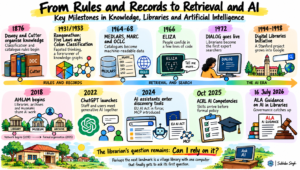
In 1994, the US National Science Foundation launched its Digital Libraries Initiative. One of its Stanford projects involved Larry Page and Sergey Brin. Their work on the web as a collection led to BackRub, PageRank and, eventually, Google in 1998.
The prototype even used equipment funded through the Digital Libraries Initiative.
So yes, librarians and digital-library researchers were present near the beginning of the story.
And then the timeline gets fascinating.
In 1964, MEDLARS demonstrated what computers could do with huge bodies of biomedical literature.
Between 1966 and 1968, the Library of Congress developed the MARC Pilot Project, turning bibliographic records into machine-readable data.
In 1967, OCLC began building a cooperative, computerised approach to library cataloguing.
In 1966, ELIZA showed something else.
People would talk to a machine as if it understood them.
A few lines of scripted pattern matching were enough to create the illusion of conversation. Every library chatbot since then has had to deal with some version of the same problem: users often trust the appearance of intelligence before checking the evidence.
Then came DIALOG in 1972.
Librarians became expert searchers, constructing precise queries across bibliographic databases.
Prompt engineering?
We had another name for it.
Professional searching.
Then came the Digital Libraries Initiative.
Then AI4LAM in 2018.
Then ChatGPT in 2022.
Then AI assistants entered discovery systems and research workflows.
And in 2024, the EU AI Act entered into force while the Model Context Protocol appeared as another important piece of the emerging AI infrastructure.
The last two years brought another interesting shift.
We trained before we wrote the rules.
ACRL approved its AI Competencies for Academic Library Workers in October 2025. The framework covers ethical considerations, AI knowledge, evaluation and practical application.
Then, on 16 July 2026, ALA Council adopted its Guidance on the Use of Artificial Intelligence in Libraries.
Skills first.
Governance followed.
The worry has also changed.
Earlier, the question was:
“Should libraries adopt AI?”
Increasingly, the question is:
“Can we trust what AI gives us?”
A 2026 study of 75 Indian libraries reported 85% AI adoption in urban libraries compared with 20% in rural libraries, with an overall figure of 52%.
The overall number looks encouraging.
The rural-urban gap tells a different story.
That gap is large enough to remind us that AI literacy without equitable access is incomplete.
Tools change every season.
The librarian’s fundamental question has not changed.
Not only:
“Where is the information?”
But:
“Can I rely on it?”
Perhaps the next landmark worth celebrating will not be another AI platform.
Perhaps it will be a village library with one computer, reliable connectivity and a librarian who finally gets to ask an AI system the first question.
Which landmark would you add to this timeline?